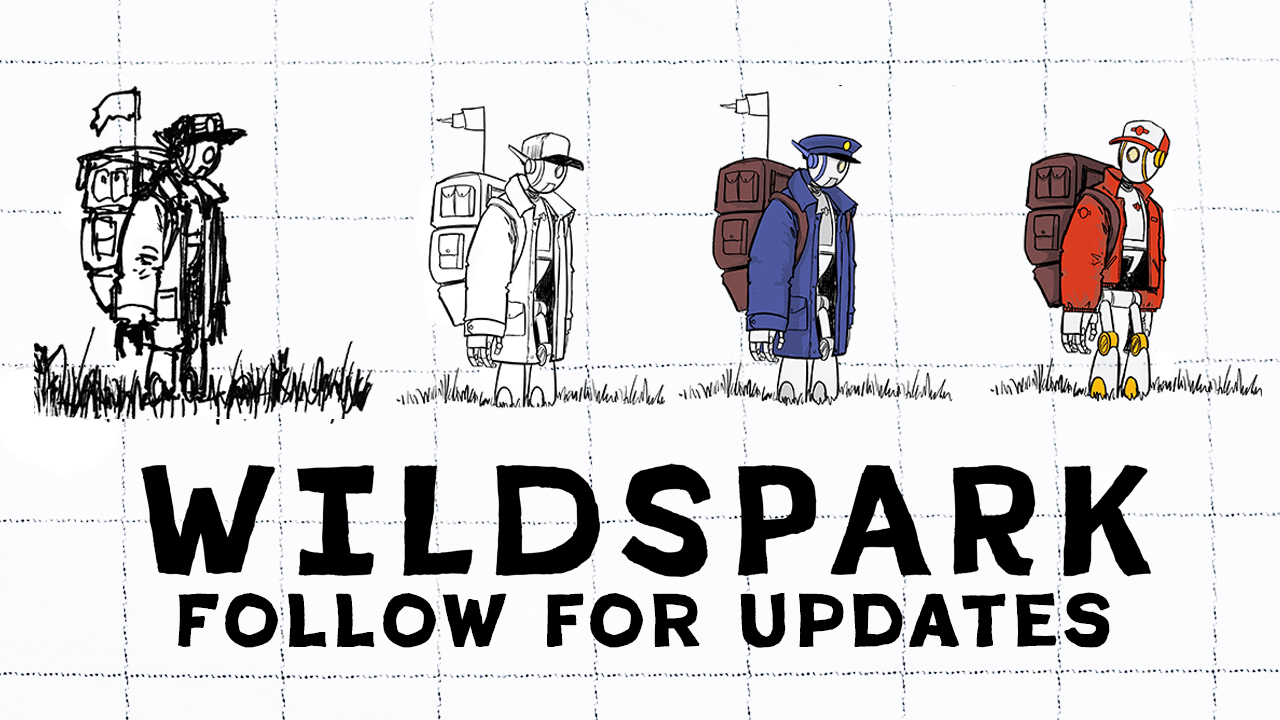
Wildspark is a solo journaling roleplaying game about exploration and self-discovery in a verdant post-apocalyptic world. You play as a Pilgrim, a robot designed to explore the new wilderness whilst discovering their own humanity along the way.
In today's blog: Why are we doing a dev log? How did Wildspark come to be? What are the next steps?
TLDR: This blog is going to be about the creation of a new game, Wildspark. It is going to cover the whole process of making the game, from concept to completion, and show what goes into making an RPG. This post covered the initial concept (a very loose idea) of a travelling game, set in nature, that is super rules-light. We mused several options until two separate ideas came together to really give us an idea we loved. We reached out to an artist and writer who we felt could bring the world to life and now are looking at three key areas; writing the world, exploring the visual style, and developing the rules - with future blog posts looking at these in more detail.
When you are travelling, getting from A to B can be dull. Really, really dull. There’s only so many times you can sing loudly in the car to “Don’t Stop Believing” or play “I see a Cow” (top tier car-based entertainment). But luckily when you work for a games company, work travel becomes 30% eating food and 70% talking excitedly about all the games we want to make. And that is how the story of Wildspark began. Me (Matt, hi!) and Charlie were flying to the US last year, and in-between geography lessons (where exactly is Kentucky?) we were talking about all the games we enjoy, and the games we want to make one day. And there are a lot.
A few themes kept coming up though, nature, walking games, and post apocalyptic settings.
After we returned from the US we got back to work on other projects and, over the year, we kept coming back to the idea of a game where you travel through an overgrown world. The seeds were well and truly sown…
Why This Blog? We thought it would be fun, as we travel through this project, to bring you along with us! As a small company (we only have 4 full time employees) sometimes we are so focused on the products we are working on, we don’t take the time to stop and talk about them to the lovely people who play them. So we thought for a change, let's bring you along on the journey with us! You can see the rules and the art grow as we build the world out. Maybe see a little bit of what goes into making a game along the way, and even experience the “fun” of the problems we run into.
I’ll update the blog over the next few months as I have things to share, but also feel free to leave comments or reach out with any questions and I’ll do my best to answer them.
So, Wildspark?! With the ideas permeating for a few months, as these things do, we talked lots of other ideas - some that may come in the future (looking at you Cthulhu mythos) and some that may never see light (Dungeons and Dinner Parties), but this unnamed post-apocalyptic exploration game kept coming back to us. We knew there were a few things we loved in this idea and wanted to explore more:
1) An overgrown, nature-taking over, post-apocalypse. Not a huge war - this isn’t a Mad Max apocalypse. We wanted a world where nature is front and center, not humanity. 2) Travelling and exploring the world would be a key focus in the game, not as a background to a narrower action heavy experience. 3) The most rules light focus we’ve ever had. We knew that this game needed a focus on story telling and emotion, and didn’t want heavy rules to contend with this.
And so with this in mind…we went off and thought on it some more. There's really a lot of time in most of our projects between "Here's a cool idea" and "Here's a well-thought out idea". The bit in between can be the most important as having those kernels of thought rattling around your brain overtime can develop and latch on to parts of other conversations, until a time it blooms into something new.
We had several ideas for the game at this time that we discussed, and whilst we liked them, we never loved them enough to push on . These included: - A 2-person game with a knight and their squire travelling through a magically charged world - A game you literally play whilst on a group walk (an idea we really want to come back to) - A lost child travelling through the world to seek their lost family after being separated
DESIGNERS NOTE: If any of these paused ideas sound like fun and you’d like to see them in the future, let us know in the comments!
But nothing seemed to quite fit what we were going for. Until...
The Stars Align One day I was scrolling through the internet and I saw someone using cards to alter scenes for their D&D game. So you pull a word out and this gives you some flavour for the scene. They were using Tarot cards, so if you pulled the “Emperor”, the scene might have a feeling of Power - whilst pulling Judgement might inspire a new start.
I loved this idea, having an external motivation that gave you a changing status for a scene that isn’t necessarily driven by the encounter. It gives another level of change in the world. As I thought more on this I struck on the idea of emotions. I love when a game explores different feelings, and I imagined a game where you were forced to approach challenges with changing emotions, battling with the feelings inside against your outside motivations.
At the same time Charlie had been thinking about the post-apocalyptic world. He had started developing ideas about Robots that travelled the world connecting the existing parts of civilisation. A hyper-verdant landscape where small groups of surviving humans gather in small, sheltered communities, it being impossible to cross the wilds that separate them. These robots were their life-line and last remaining connection to others across the land.
We happened to have a lunch-meeting booked at our local favourite Lebanese restaurant, and excitedly started telling each other our ideas. And we realised that, after months of musing, these ideas aligned perfectly! A robot who connects the survivors in the world, who learns from them and experiences their emotions! Who grows and changes, who develops, who has a real story.
Wildspark was born, and we knew just the missing parts of the team!
Time to Make The Game Back in 2025 I was at Comicon in London and was doing my favourite thing at these shows, exploring all the art on display. Seriously - if you attend Comicon, Gencon, UKGE, or any other con - make sure you devote some time to Artist Alley - it is the most inspirational place in the show. On this trip, I got chatting with the delightfully friendly Phil Chapman, the artist behind System Error Comics.
Phil not only does amazing art, but also loves games and was a big fan of ION Heart. Initially I spoke to him about coming on board to help Ben with some ION Heart work but this never came to be. However, I loved his style and knew the right project would eventually come along.
And then, a year later, we had an overgrown world with a robot travelling through…and honestly I cannot think of a better match!
I reached out to Phil tentatively asking if he was interested in the idea - and got an emphatic “I’M IN!” before I had even finished our pitch.
And then we drove an hour up North to go and speak with Adam, who is a fantastic wordsmith responsible in-part for bringing Shiver, ION Heart, and Sisterhood all to life. He had to be the one writing this. Adam is a phenomenal world builder and putting him as lead writer on this project would leave no stone unturned.
Like Thanos with his infinity gauntlet filled we were ready to bring about the (nature drive and very wholesome) apocalypse. Just the small task left of, you know, making the game!
But, where’s the game?
A big discussion I’ve had many times and always enjoy is what comes first, mechanics or theme? Having worked in boardgames and roleplaying games this is a great question that to me crosses both these genres, as well as the wider games industry (including video games). Some people will say that you have to start from the theming and make the rules fit, whilst others argue that you need to create a great mechanic first and then layer the right theme on top.
To me, both these things are true. And equal.
I honestly believe that both these directions are entirely valid and can both make for an incredible game. For Wildspark we are very much starting with a world-first approach. We know the theme we want, and we know how we want the game to feel. We know what we are aiming for players to feel and experience as they journey through our world.
What we don’t know is…how. We haven’t settled on a resolution mechanic*, we’ve discussed cards or dice as the primary options - but nothing is written out. We even briefly discussed no resolution mechanic and making it far more freeform - but decided we wanted something to drive the unknown.
This means at the moment we are playing around with some different ideas, throwing everything we can think of that fits the theme, and seeing what we like! When we hit something we will vibe with it, and start iterating down to refine it into a system we like. But we know already that we want this to be our most rules-light game to date. *eg rolling a dice to determine the outcome of an unknown event, like an attack in D&D
So, Where Are We Now! With the very basics set out, more a feeling than a game at this point, we generally start with a couple of routes: 1) Individually everyone on the team thinks about their version of the game, what they want to see and what they want to play. 2) As a group we have (over excited) chats where we discuss our ideas. 3) We create shared documents filled with resources, notes, and inspirations - before a word gets written.
We started with a Miro board, showing words that resonate, a game overview, some inspiration, as well as some colours (shown below).
Now we have to look at the 3 pillars; Mechanics, Lore, and Art. We have started the process on each of these steps (I’ll go through each one in a bit more detail explaining what we’ve tried, what worked (and didn’t) and how we are developing this - and hopefully you will want to join us on this journey!
To give you a bit of a sneak peek of what’s to come, below you can see some of Phil’s concept work for your robots, or your “Pilgrims” as they are now called!
If you have any questions, add them to the comments or jump in to our Discord (https://discord.gg/StcqgYjv7u) and I’ll do my best to answer them!
Until next time
Matt
About Me
Hi I’m Matt! I’m the CEO at Parable Games and previously worked at Gale Force Nine as the studio manager, working heavily on their D&D and boardgame projects. I also published D&D content as “Dungeon Rollers” before joining my friends Barney & Charlie at Parable Games where I could get back to working on roleplaying games full time. Being a small company I get involved in a bit of everything, whether it is sorting boxes in the warehouse, building our website, helping out on game design, or shipping our games round the world - at a company like Parable we all get stuck in. I’ve worked in the games industry in some form for over 20 years now (it flies by!) and am aiming for at least another 20. In this blog I’m hoping to show people behind the scenes of making a game, and hopefully encourage some people to try making their own!
We use essential cookies and our own first-party analytics to run BackerKit. With your consent, we also use cookies to measure our marketing and share data with advertising partners to show you relevant ads. Accept to allow all cookies, or reject to turn off the optional ones.
Read our cookie policy.